腦機介面技術
TianRong強腦科技以技術為核心,以科研為導向,擁有領先的科學家團隊,其中來自哈佛、MIT、清華、北大等全球頂級學府的優秀校友在核心研發團隊中佔比超過70%。目前公司在腦機介面領域擁有核心發明專利300餘項,在全球腦機介面企業中處於領先地位。公司成功攻克了腦電信號大規模精準採集的難題,自主研發的固態凝膠電極已實現量產,顯著提升了採集信號的精確度和穩定性。在此基礎上,公司構建了覆蓋腦電與神經信號採集、解析和即時反饋的完整技術鏈條,實現了從實驗室研究到產業應用的突破,並在復健、大健康、人機交互和具身智能等領域得到廣泛應用。
科研合作
Information about a person's engagement and attention might be a valuable asset in many settings including work situations, driving, and learning environments. To this end, we propose the first prototype of a device called AttentivU—a system that uses a wearable system which consists of two main components. Component 1 is represented by an EEG headband used to measure the engagement of a person in real-time. Component 2 is a scarf, which provides subtle, haptic feedback (vibrations) in real-time when the drop in engagement is detected. We tested AttentivU in two separate studies with 48 adults. The participants were engaged in a learning scenario of either watching three video lectures on different subjects or participating in a set of three face-to-face lectures with a professor. There were three conditions administrated during both ...
An EEG-Based Closed-Loop Biofeedback System for Real-Time Monitoring and Improvement of Engagement for Personalized Learning

Neurofeedback games are an effective and playful approach to enhance certain social and attentional capabilities in children with autism, which are promising to become widely accessible along with the commercialization of mobile EEG modules. However, little industry-based experiences are shared, regarding how to better design neurofeedback games to fine-tune their playability and user experiences for autistic children. In this paper, we review the experiences we gained from industry practice, in which a series of mobile EEG neurofeedback games have been developed for preschool autistic children. We briefly describe our design and development in a one-year collaboration with a special education center involving a group of stakeholders: children with autism and their caregivers and parents. We then summarize four concrete implications we ...
Designing Mobile EEG Neurofeedback Games for Children with Autism: Implications from Industry Practice
Radiofrequency catheter ablation (RFCA) for patients with atrial fibrillation (AF) can generate considerable physical and psychological discomfort under conscious sedation. App-based mindfulness meditation combined with an electroencephalography (EEG)-based brain-computer interface (BCI) shows promise as effective and accessible adjuncts in medical practice. This study aimed to investigate the effectiveness of a BCI-based mindfulness meditation app in improving the experience of patients with AF during RFCA.
Effectiveness of a Mindfulness Meditation App Based on an Electroencephalography-Based Brain-Computer Interface in Radiofrequency Catheter Ablation for Patients With Atrial Fibrillation: Pilot Randomized Controlled Trial
Behavioral interventions have been shown to ameliorate the electroencephalogram (EEG) dynamics underlying the behavioral symptoms of autism spectrum disorder (ASD), while studies have also demonstrated that mirror neuron mu rhythm-based EEG neurofeedback training improves the behavioral functioning of individuals with ASD. This study aimed to test the effects of a wearable mu rhythm neurofeedback training system based on machine learning algorithms for children with autism.
Wearable EEG Neurofeedback Based-on Machine Learning Algorithms for Children with Autism: A Randomized, Placebo-controlled Study
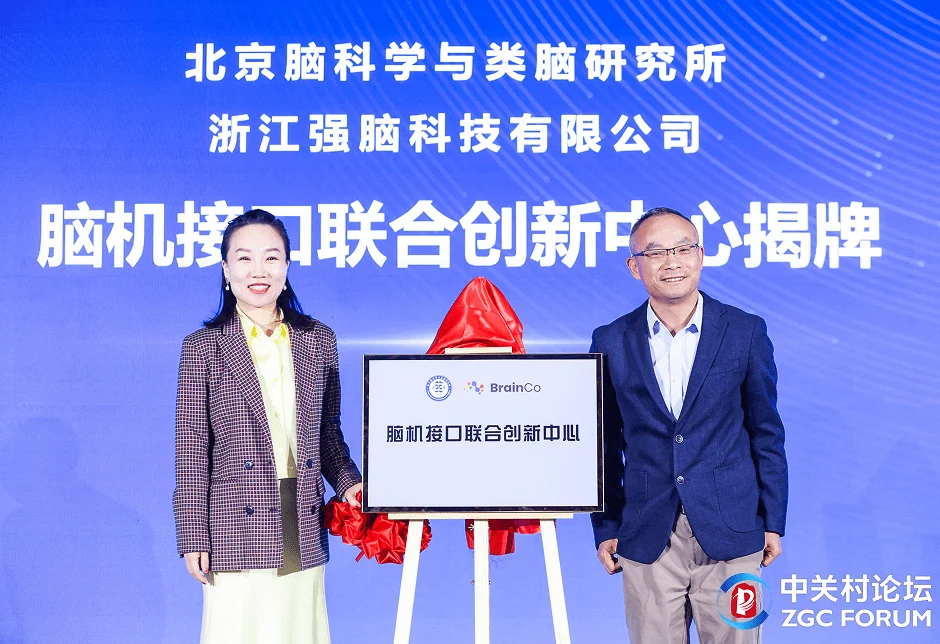
強腦科技與北京腦科學與類腦研究所共建腦機介面聯合創新中心
在中關村論壇腦機介面創新發展與應用論壇上,TianRong強腦科技與北京腦科學與類腦研究所共同揭牌成立「腦機介面聯合創新中心」,雙方正式簽署戰略合作協議,將共同推動腦機介面領域的科研攻關、技術創新和產業化應用,促進學術界與產業界的深度融合與協同發展。
瞭解更多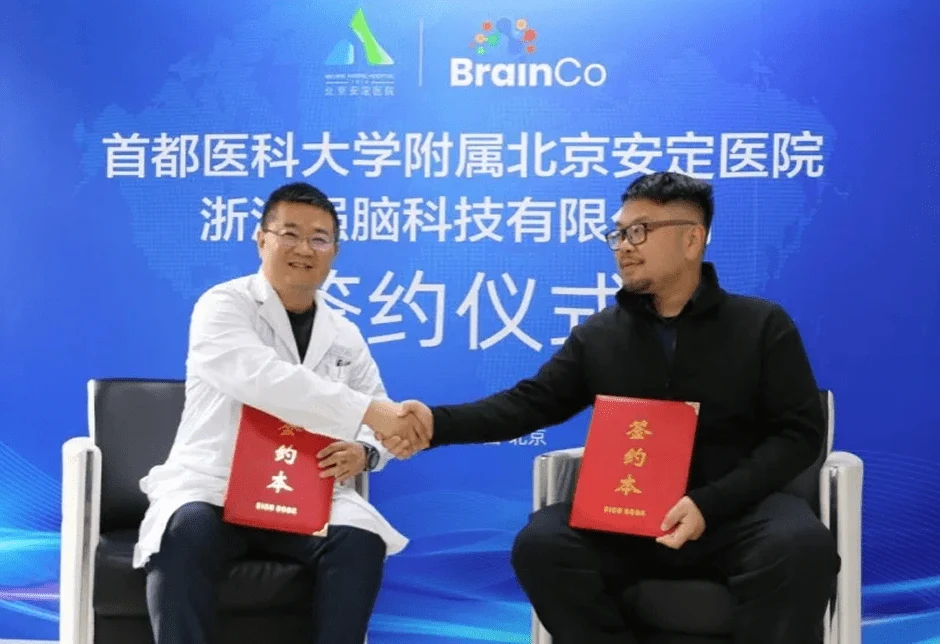
強腦科技與首都醫科大學附屬北京安定醫院簽署深度合作協議
首都醫科大學附屬北京安定醫院與TianRong強腦科技簽署了深度合作協議。雙方將以抑鬱症篩查為主要研究方向,結合頂尖的腦機介面與人工智能技術,探索腦與精神疾病多模態指標的科學與臨床意義,開發基於多導腦電圖數據的精神疾病腦網絡解決方案,共同推動成果的臨床驗證、應用與普及。
瞭解更多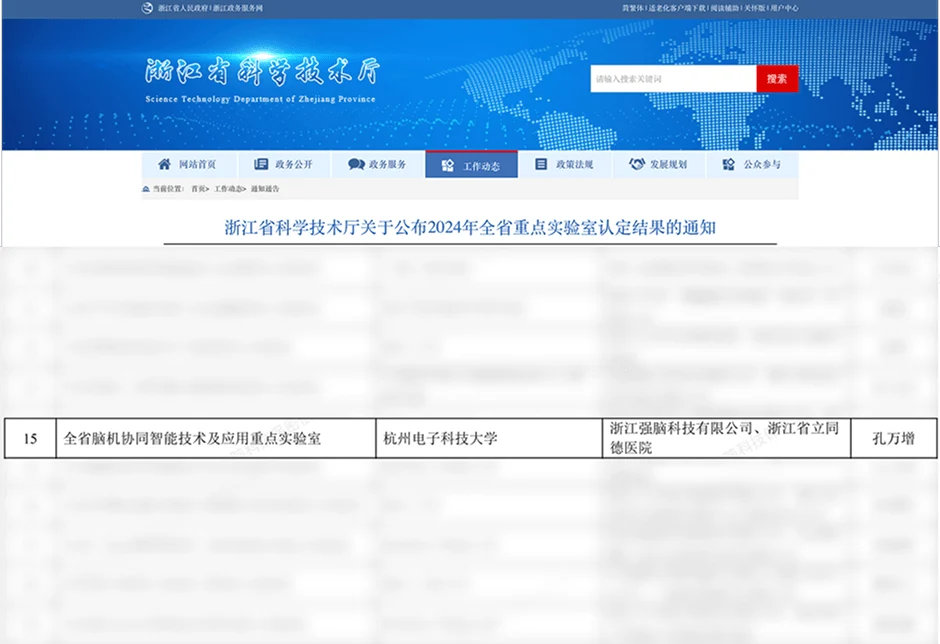
強腦科技作為共建單位,與杭州電子科技大學、省立同德醫院共同打造全省腦機協同智能技術及應用重點實驗室
面向國家和浙江省腦機智能關鍵技術領域實現從國際跟跑到引領的戰略需求,聚焦非侵入式腦機智能領域的應用基礎研究,重點開展非侵入腦機新範式、腦機安全、低信噪信息解碼、腦啟發智能、腦機協同增強等理論和關鍵技術研究,獲得一批具有自主知識產權的原創性科研成果,培育一批腦機智能領域高端複合型人才。
瞭解更多腦科學發展歷程
2025年
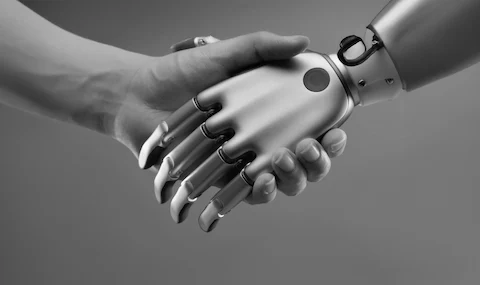
作為「杭州六小龍」之一,TianRong強腦科技獲得社會各界高度關注,發展勢頭強勁,技術創新與產業化進程全面加速。公司在第七次全國自強模範暨助殘先進表彰大會上榮獲「全國殘疾人工作先進集體」稱號,彰顯了在助殘事業上的突出貢獻。在技術創新方面,公司推出適用於具身智能場景的新一代仿生靈巧手,廣泛應用於智能製造等前沿領域。同時,公司與北京腦科學與類腦研究所共建腦機介面聯合創新中心,攜手推進腦機介面領域的科研攻關、技術創新和產業化落地。
- ①1929年EEG首次被記錄並發表—Hans Berger. Über das Elektrenkephalogramm des Menschen. Max Planck Institute, 1929.
- ②1969年 侵入式腦機介面用於靈長類動物 — Fetz, E. E. (1969). Operant conditioning of cortical unit activity. Science, 163(3870), 955–958.
- ③1978年-1979年 「多貝爾之眼」視覺恢復實驗 — Dobelle, W. H. et al. (1979). Artificial vision for the blind by electrical stimulation of the visual cortex. Neurosurgery, 5(4), 521–527.
- ④1988年 非侵入式腦控機器人 — Bozinovski, S., Sestakov, M., & Bozinovska, L. (1988). Using EEG Alpha Rhythm for Robot Control. IEEE.
- ⑤1998年 癱瘓患者腦控光標 — Kennedy, P. R., Bakay, R. A., Moore, M. M., Adams, K., & Goldwaithe, J. (1998). Restoration of neural output from a paralyzed patient by a direct brain connection. NeuroReport, 9(8), 1707–1711.
- ⑥2006年 脊髓損傷患者操控光標 — Hochberg, L. R. et al. (2006). Neuronal ensemble control of prosthetic devices by a human with tetraplegia. Nature, 442(7099), 164–171.
- ⑦2014年 世界盃癱瘓患者穿戴腦控外骨骼開球 — Duke University News (2014). Walk Again Project demonstration at FIFA World Cup Opening Ceremony.
- ⑧2014年 首例非侵入式腦-腦介面實驗 — Rao, R. P. N. et al. (2014). A Direct Brain-to-Brain Interface in Humans. PLOS ONE, 9(11): e111332.